
The Fire Comes Back to the Ridge
In January, on a Stanford preserve in the Santa Cruz foothills, the Muwekma Ohlone Tribe lit its first cultural burn in nearly a century and a half. Nine months later, the science is in print, and California is still deciding who gets to carry the fire.
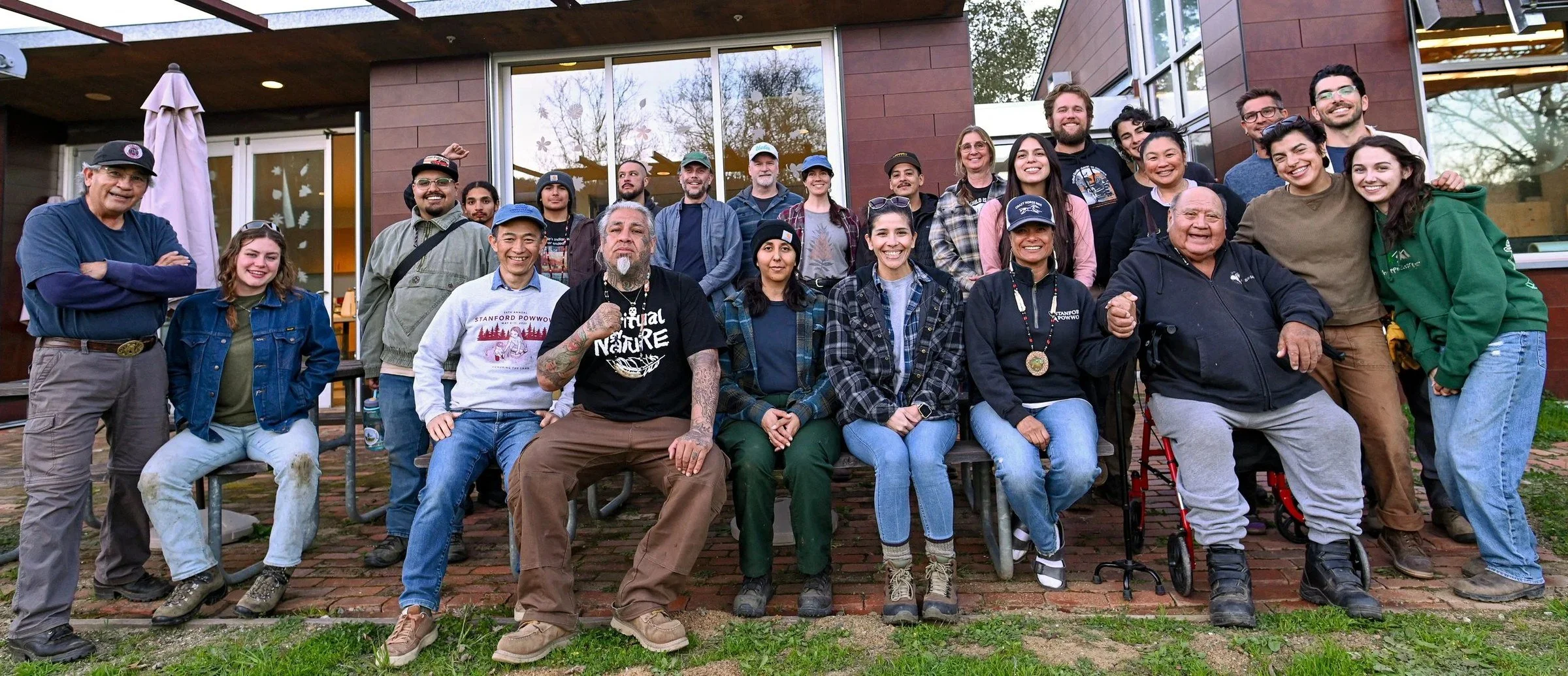
Participants in the Muwekma Ohlone Tribe’s cultural burn training at ’Ootchamin ’Ooyakma (Jasper Ridge Biological Preserve), January 2026. Photo: Marina Luccioni / Muwekma Ohlone Preservation Foundation
Before anything was lit, there was the circle. In late January, about 60 people stood together in oak woodland near the main gate of Jasper Ridge Biological Preserve, off Sand Hill Road. They were Stanford students and faculty, preserve staff, firefighters, and members of two tribes. Tribal members lit sage and cleansed each person in turn. Then Joseph “Joey” Iyolopixtli Torres, the culture bearer of the Muwekma Ohlone Tribe of the San Francisco Bay Area, led the group in prayer.
The piles had been built that same day from freshly cut coast live oak and coyote brush: 13 of them, on a two-acre site ringed by an unpaved road that would serve as a firebreak if needed. Nothing went on a pile that was thicker than an adult’s arm. Nobody used a drip torch, the fuel canister crews use to lay flame across a hillside. The fires were started with a lighter.
Smoke curled toward a blue sky, as Stanford’s news office later described the scene. Charlene Nijmeh, the Tribe’s chairwoman, pulled dry branches from a nearby grove, set them on a crackling pile, and stopped to watch it burn. “We want to listen to what the land needs and have the land hear what we want,” she said, in remarks published by Stanford Report. “It is a reciprocity, and it comes with respect. Fire gives life to the land, and everyone benefits from this living spirit, just as we benefit from all elements around us.”
“We want to listen to what the land needs and have the land hear what we want. It is a reciprocity, and it comes with respect.” —Charlene Nijmeh, chairwoman, Muwekma Ohlone Tribe
By Stanford’s account, it was the Muwekma Ohlone’s first cultural burn in nearly a century and a half. Colonization, and later the law, had broken the practice across the Tribe’s ancestral homeland.
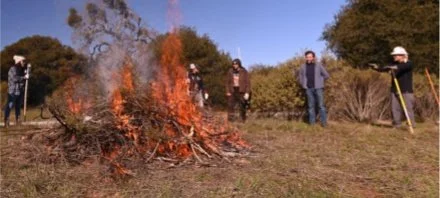
One of the 13 piles burned at ’Ootchamin ’Ooyakma on Jan. 23, 2026. Photo: Marina Luccioni, from Golde et al., microPublication Biology (2026), CC BY 4.0; cropped
The fires were small, and what they carried was not. In the nine months since, the January burn has become a test case. In August, the Tribe’s leaders and a class of Stanford undergraduates published a peer-reviewed study of what the fire did to the living soil underneath it. In September, the preserve won a national award for the partnership behind it. This fall, California is pushing harder than ever to put “good fire” back on the land, and the oak woodlands that cultural burning was partly meant to protect are coming into acorn season. Against that backdrop, the burn at Jasper Ridge raises a question the state’s own laws haven’t fully answered: when fire comes home, who is allowed to carry it?
Red Ridge
Jasper Ridge is a 1,193-acre preserve in the eastern foothills of the Santa Cruz Mountains, Stanford’s “living laboratory” since 1973. In the Tribe’s Chochenyo language it is ’Ootchamin ’Ooyakma, which means red ridge, or red mountain. The preserve’s land acknowledgment, written with the Muwekma Ohlone Tribe, says it sits on the Tribe’s ancestral land, and stone mortars and pestles, the tools for grinding acorns, have been photographed near the preserve’s field station.
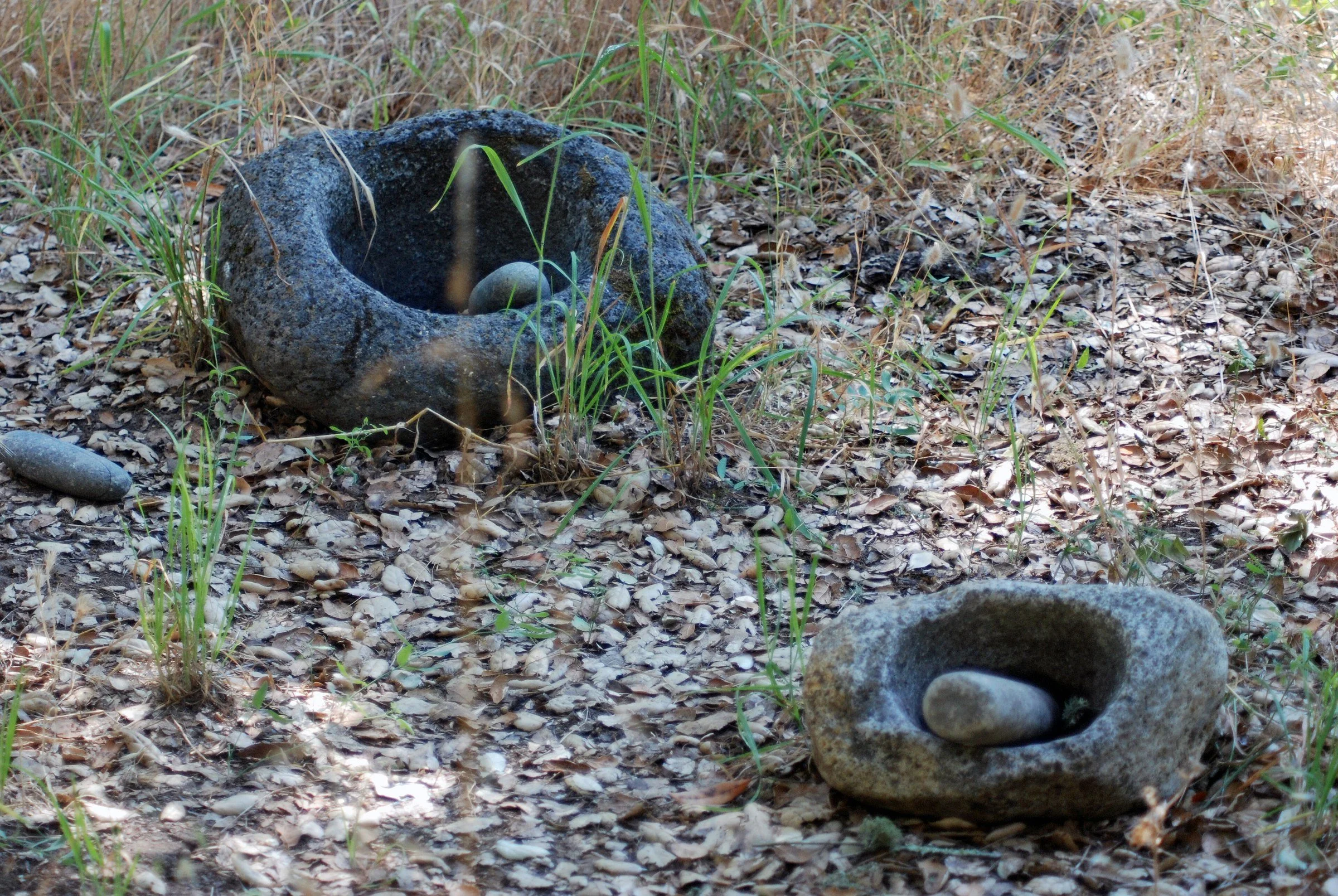
Ohlone mortars and pestles near the Jasper Ridge Biological Preserve field station. Photo: Schmiebel / Wikimedia Commons, CC BY-SA 3.0
For most of its half century as a preserve, Jasper Ridge kept fire out. It ran a few small controlled burns in 2001 and 2011 and used goats to graze down fuel. In 2023 the biologist Tadashi Fukami became faculty director and steered the preserve toward “two-eyed seeing,” an approach that treats Indigenous and Western science as independent but complementary ways of knowing.
The first fires under that approach came in March 2024. To build a fuel break along the preserve’s Westridge boundary, a professional crew working under a CAL FIRE permit burned nearly 200 piles of cut chaparral over four days. Before they started, Torres shook a clapstick and offered a blessing in Chochenyo while sage smoldered in an abalone shell. “We are finding connection to the land by opening it up with sacred fire. The fire is life,” he told Stanford Report at the time. Nijmeh said it more plainly: “We are connecting back to our land and learning the old ways and traditions of our ancestors. This fire is part of that process.”
Six months later, preserve scientists found fire-adapted chaparral pushing back in around the edges of the burned piles. Among the new growth was a plant they hadn’t seen there before the fire: western bewildering bushmallow, a shrub that grows only in the San Francisco Bay Area. California’s rare-plant rankings list it as “fairly threatened.” It had apparently been waiting in the seed bank.
Still, 2024 was a prescribed burn: professionals designed and ran it, and the Tribe blessed it. This January was different.
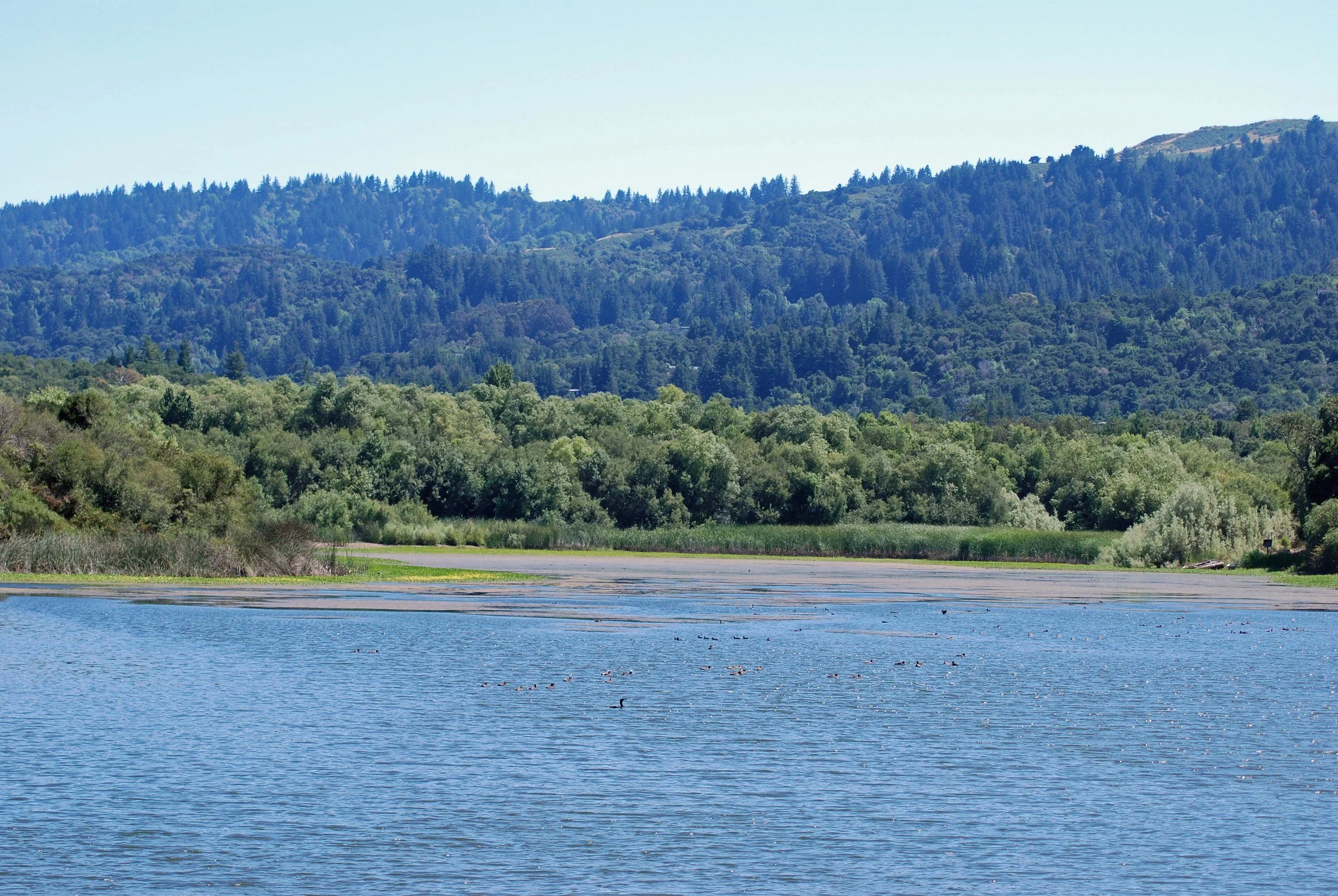
Looking south across Searsville Reservoir in Jasper Ridge Biological Preserve, Portola Valley. Photo: Schmiebel / Wikimedia Commons, CC BY-SA 3.0
A Crime for Two Centuries
By one widely cited estimate, which accounts for the deliberate burning of Native peoples, about 1.8 million hectares of California burned in an average year before 1800. That is roughly 4.5 million acres. “Skies were likely smoky much of the summer and fall in California during the prehistoric period,” the fire scientist Scott Stephens and his colleagues wrote in the 2007 study that produced the figure.
Spanish authorities saw that smoke as a threat to their pastures. On May 31, 1793, José Joaquín de Arrillaga, California’s interim governor, issued a proclamation meant to “uproot this very harmful practice of setting fire to pasture lands.” The ban applied not only near settlements “but even at the most remote distances.”
California’s government now speaks openly about what followed. Announcing an executive order last October, Gov. Gavin Newsom’s office said tribal cultural fire practices “were outlawed by state and federal authorities” over two centuries, “leading to immense harm and disruption in the lives of California Native Americans.” A 2024 state law puts it more bluntly, citing the need “to address the historical wrongs of criminalizing cultural use of fire.”
The bill for that exclusion is visible on Bay Area hillsides. Sheena Sidhu, a Jasper Ridge staff scientist, explained to Stanford Report in 2024 that decades of fire suppression had left a buildup of vegetation. Some of the brush crews cleared at the preserve hadn’t been touched in nearly a century. “We can assume that a fire will come through at some point,” Sidhu said.
The Difference Between a Fire and a Prayer
To Nijmeh, the gap between 2024 and this January isn’t a technical one. “The prescribed burn is about land management, but a cultural burn has part of our essence in the land,” she said in the Stanford account. “It’s about prayer and giving thanks when we are on this land.”
The Tribe didn’t relearn the practice alone. Members of the North Fork Mono Tribe came at the Muwekma Ohlone’s invitation to guide the burn. Ron Goode chairs the North Fork Mono Tribe and serves as the Muwekma Ohlone’s cultural burn adviser. His tribe has been “instrumental in sharing cultural burning knowledge across California,” according to the preserve; in 2024 it was among the tribes that led Save the Redwoods League’s first cultural burn, at Alder Creek Grove in the Sierra Nevada.
“It’s not about the fire, not about the flame. It’s about revitalizing our culture—either culture we have lost or culture we were unable to maintain,” Goode said at Jasper Ridge. “This is to refresh, renew, revitalize, but not destroy.”
“It’s not about the fire, not about the flame. It’s about revitalizing our culture.” —Ron Goode, chairman, North Fork Mono Tribe
Tribes that practice cultural burning may burn two or three times a year, Goode explained, depending on what the land needs. Smoke kills mistletoe, a parasite of oaks. Thinning the understory brings back what he called “see through,” the open sightlines that historically helped tribes manage the land.
Goode’s instructions also shaped what happened once the flames were out. In nine of the 13 piles, participants raked the ash and charcoal into the topsoil to return nutrients and help culturally important plants grow. The other four were left alone, with the ash on the surface, for the animals. According to the study that followed, deer and small mammals have been seen rolling, pawing and dust-bathing in ash like this to get rid of fleas, ticks and mites.
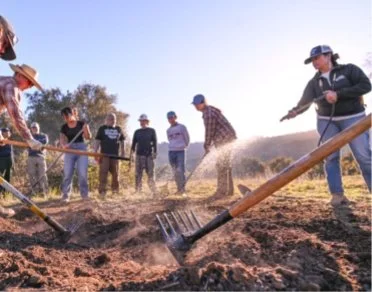
Following North Fork Mono practice, participants rake ash into the topsoil after a pile has burned. Photo: Marina Luccioni, from Golde et al., microPublication Biology (2026), CC BY 4.0; cropped
Dirk Charley, a member of the Dunlap Band of Mono Indians who works with the North Fork Mono natural resources team, came to help guide the burn and keep it safe. “Tribes know what to do through family and experience,” he said. “You can talk about it, read, share, but when they come to do it, they get that smell, they can hear, and they can feel it. That’s how you learn.”
“When they come to do it, they get that smell, they can hear, and they can feel it. That’s how you learn.” —Dirk Charley, Dunlap Band of Mono Indians
What the Soil Knew
On Jan. 27, three days after the burn, students from a new Stanford seminar called Traditional Ecological Knowledge for Land Stewardship walked back into the woodland. The course is cross-listed in biology and Native American studies. The students took soil from six of the burned piles, sampling at each pile’s center, at the edge of the ash, and two to three meters outside it.
Their question concerned acorns. Two insects, the filbertworm moth and the filbert weevil, lay eggs in California acorns. The larvae grow inside the nut, then drop and burrow into the soil, leaving acorns that often can’t germinate and are poor food for birds, mammals and people. Cultural burning before the acorn harvest has long been understood to knock those insects back. What nobody had measured was whether the fire also wipes out the insects’ natural enemies: soil nematodes that enter and reproduce in insect larvae.
Over seven weekly lab sessions, the students baited the soil with wax moth larvae, a standard stand-in, and watched what emerged.
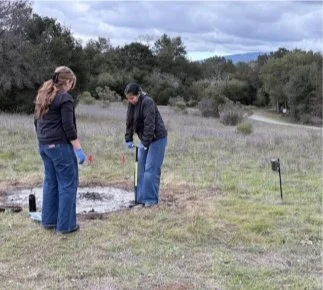
Stanford students collect soil from a burned pile three days after the cultural burn. Photo: Tadashi Fukami, from Golde et al., microPublication Biology (2026), CC BY 4.0; cropped
The answer, published Aug. 15 in the journal microPublication Biology, was mostly no. Nematodes came out of more than half of the dead larvae even in soil from the centers of the burned piles. At the edges the rate was higher. “The heat from the fire and the subsequent exposure to ash may be the likely causes of reduction in nematodes, but fire did not decimate them,” the authors wrote, and they contrasted that with intense fires, “such as wildfires and non-Indigenous prescribed burning.” A low, careful fire, in other words, may hit acorn pests directly while sparing the soil life that keeps them in check. That, the authors concluded, “increases the likelihood of more acorns being available for wildlife and cultural use.”
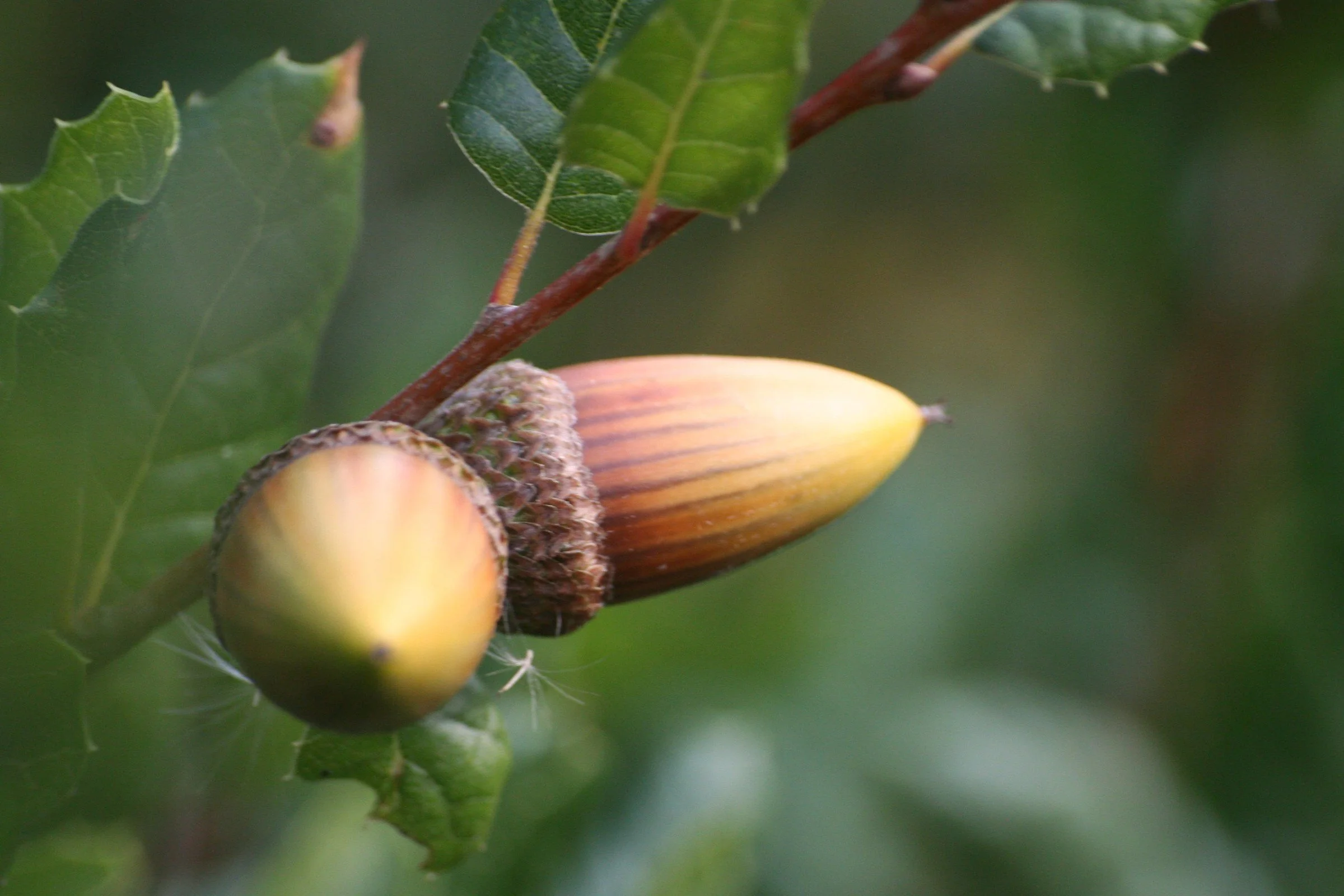
Coast live oak acorns on Mount Diablo. Insects that infest acorns are one target of cultural burning in California’s oak woodlands. Photo: John Morgan / Wikimedia Commons, CC BY 2.0
The byline says something too. Nijmeh and Torres are co-authors, along with Goode and Jesse Valdez of the North Fork Mono Tribe and every student in the class. Part of the funding was a 2025 Network for Landscape Conservation grant to the Muwekma Ohlone Preservation Foundation for an “’Ootchamin ’Ooyakma Landscape Partnership.” The team plans to keep monitoring for a year.
“Western science is a powerful tool to understand nature, but Indigenous science has been developed for generations and shows how to be part of the landscape without being too destructive,” Fukami told Stanford Report. “Having both approaches and seeing how they can be synergistic is what we need.” Yeva Allyn, a first-year student who first learned about traditional ecological knowledge growing up on Kauai, put it more simply: “I feel lucky to have been part of the burn.”
In September, the Organization of Biological Field Stations gave Jasper Ridge its 2026 Advancing Equity Award, citing, among other work, its collaboration with tribal partners on cultural burning. One committee member wrote: “This is what a land acknowledgement should be: a whole program.”
“This is what a land acknowledgement should be: a whole program.” —Organization of Biological Field Stations award committee member
Who Gets to Burn
California wants a great deal more of this kind of fire. A 2022 state strategic plan set a goal of treating up to 400,000 acres a year with beneficial fire by 2025, and 2024 climate targets call for 1.5 million acres a year by 2045. Last October, with federal burns slowed by a government shutdown, Newsom signed an order meant to keep the state from missing the “critical fall weather window.” It directed agencies to keep prioritizing tribal “consultation, access, collaboration, and co-management.”
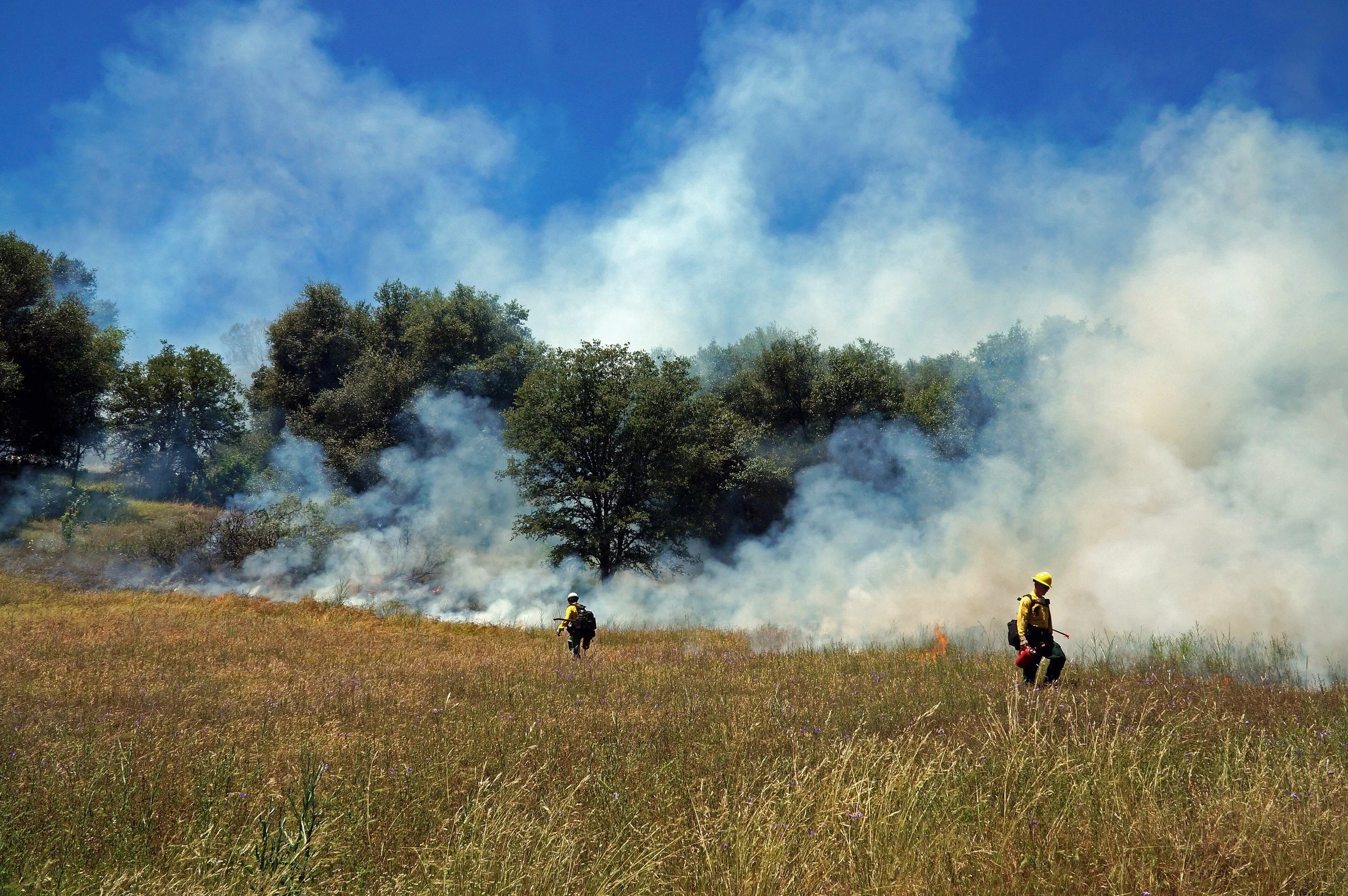
BLM and CAL FIRE firefighters conduct a prescribed burn at Cronan Ranch in the Sierra foothills, June 2019. California’s goals for “beneficial fire” cover both prescribed and cultural burning. Photo: Monte Kawahara, Bureau of Land Management (public domain)
The centerpiece of the state’s cultural-fire policy is SB 310, by state Sen. Bill Dodd. Signed in September 2024 and in effect since January 2025, it recognizes tribes’ “inherent sovereignty and authority to regulate their members and cultural practices, including, but not limited to, cultural fire practitioners and cultural burning.” It lets the California Natural Resources Agency and local air districts sign agreements that waive state burn permits and burn-plan requirements. It also protects practitioners who follow those agreements from fire-suppression costs unless they are grossly negligent. The Karuk Tribe signed the first such agreement with the state in February 2025.
The law, though, covers only “federally recognized California Native American tribes.” The Muwekma Ohlone Tribe isn’t one of them. The Bureau of Indian Affairs declined to acknowledge it in 2002, and the Tribe has kept fighting that status; as recently as June 2025, youth advocates went to Washington to lobby Congress on its behalf, KALW reported.
So the January burn happened the way a cultural burn has to happen for a tribe outside the federal list, on land it doesn’t own: through partnership and permits. The preserve announced that the burn would be coordinated with local fire agencies and overseen by a cultural fire practitioner. The published study thanks the Woodside fire marshal, CAL FIRE’s CZU unit, the Stanford Fire Department and Stanford’s land and buildings office “for support and permitting.” Even SB 310 doesn’t let anyone burn without the landowner’s permission.
That is why land is never far from the Tribe’s conversations about fire. The Foundation’s Land Acquisition Committee lists cultural burning among the practices it intends to make possible on lands held in perpetuity for the Tribe. The Tribe’s campaign to return the Presidio to its care, launched in March 2025, comes from the same impulse. “Rematriation is a justice that can be bold, transformative, even magical,” Nijmeh has said.
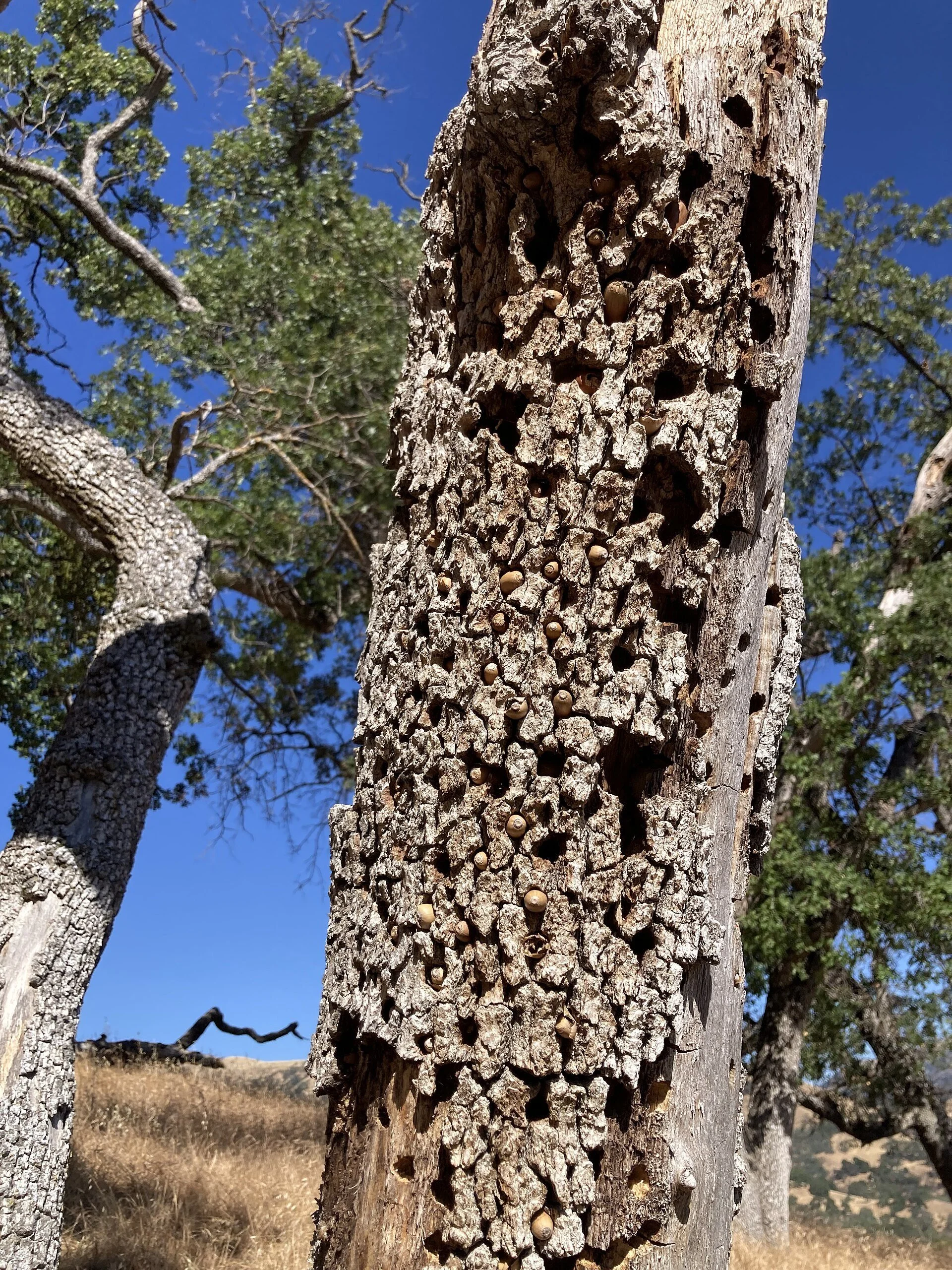
An acorn woodpecker granary at Sunol Regional Wilderness in the East Bay, June 2026. Photo: Awinch1001 / Wikimedia Commons, CC BY 4.0
The Next Fire
At Jasper Ridge, the Tribe brought its youth. The study’s authors thank “the adult and youth members of the Muwekma Ohlone Tribe for conducting the cultural burning.” Nijmeh’s hopes for the practice point in the same direction. “A lot of tribes are working on bringing back cultural burns and learning our ways that were taken,” she said. “It’s very useful in helping us understand and respect the fire. Hopefully, we teach our children to continue these methods and continue that respect to the land.”
The science will arrive on its own schedule: a year of soil monitoring, and other preserve researchers’ camera traps trained on the ash piles and 3-D models of the regrowth. The state’s rules may change, or may not. The burn’s real measure is older than any of that. Fire was set in oak woodland before the acorn harvest so that there would be good acorns to gather.
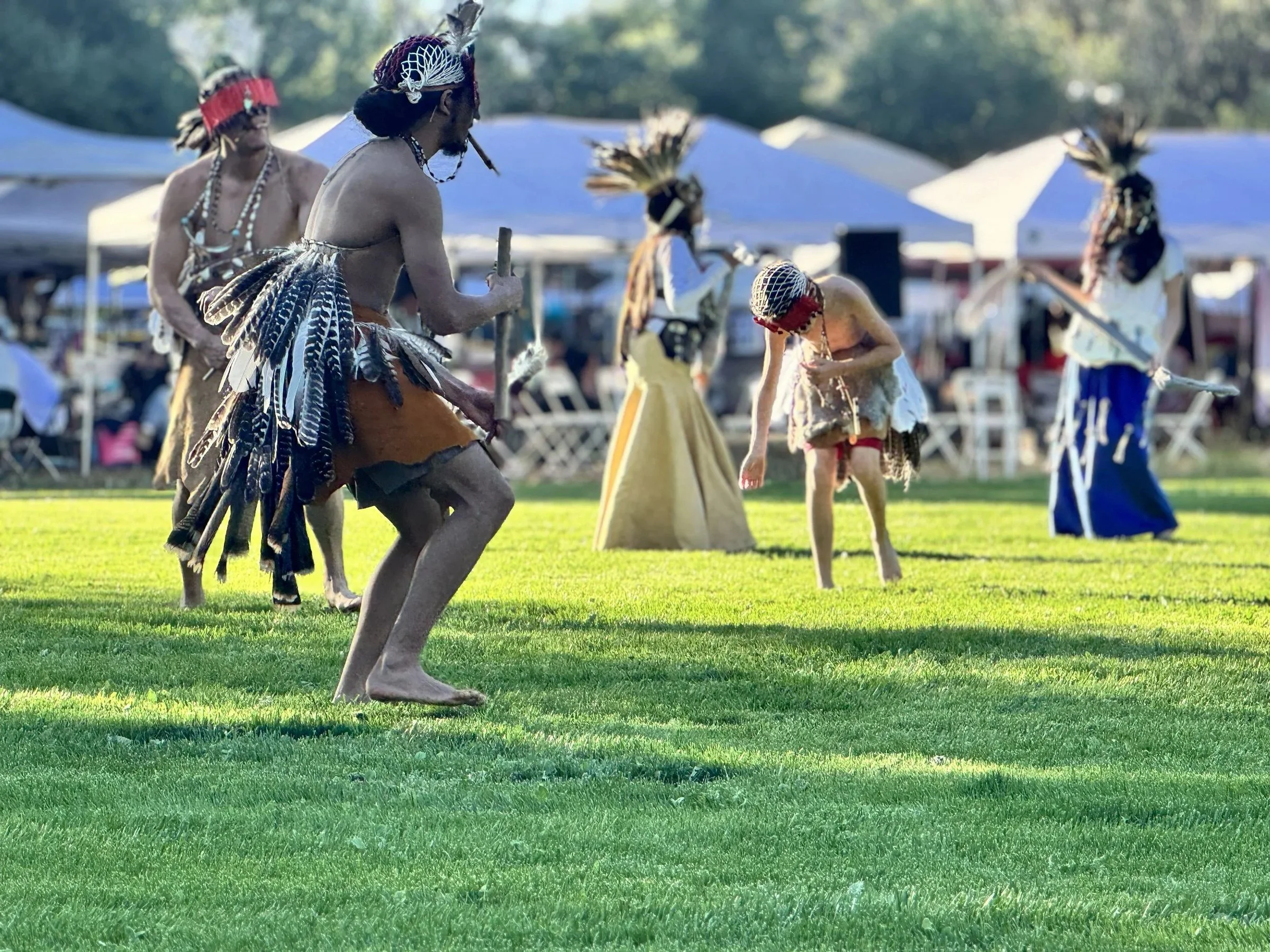
A ceremony at the Stanford Powwow. Photo: Muwekma Ohlone Preservation Foundation
“This is to refresh, renew, revitalize,” Goode said that day, “but not destroy.” The burn lasted two days. What it started, the Tribe means to keep going.
Editor’s note: Charlene Nijmeh is president of the Muwekma Ohlone Preservation Foundation, which publishes this newsletter, and Joseph Torres serves on its board. The Foundation received the Network for Landscape Conservation grant that helped fund the research described here. All quotations in this article come from previously published sources, listed in the accompanying source notes.