
Tadashi Fukami
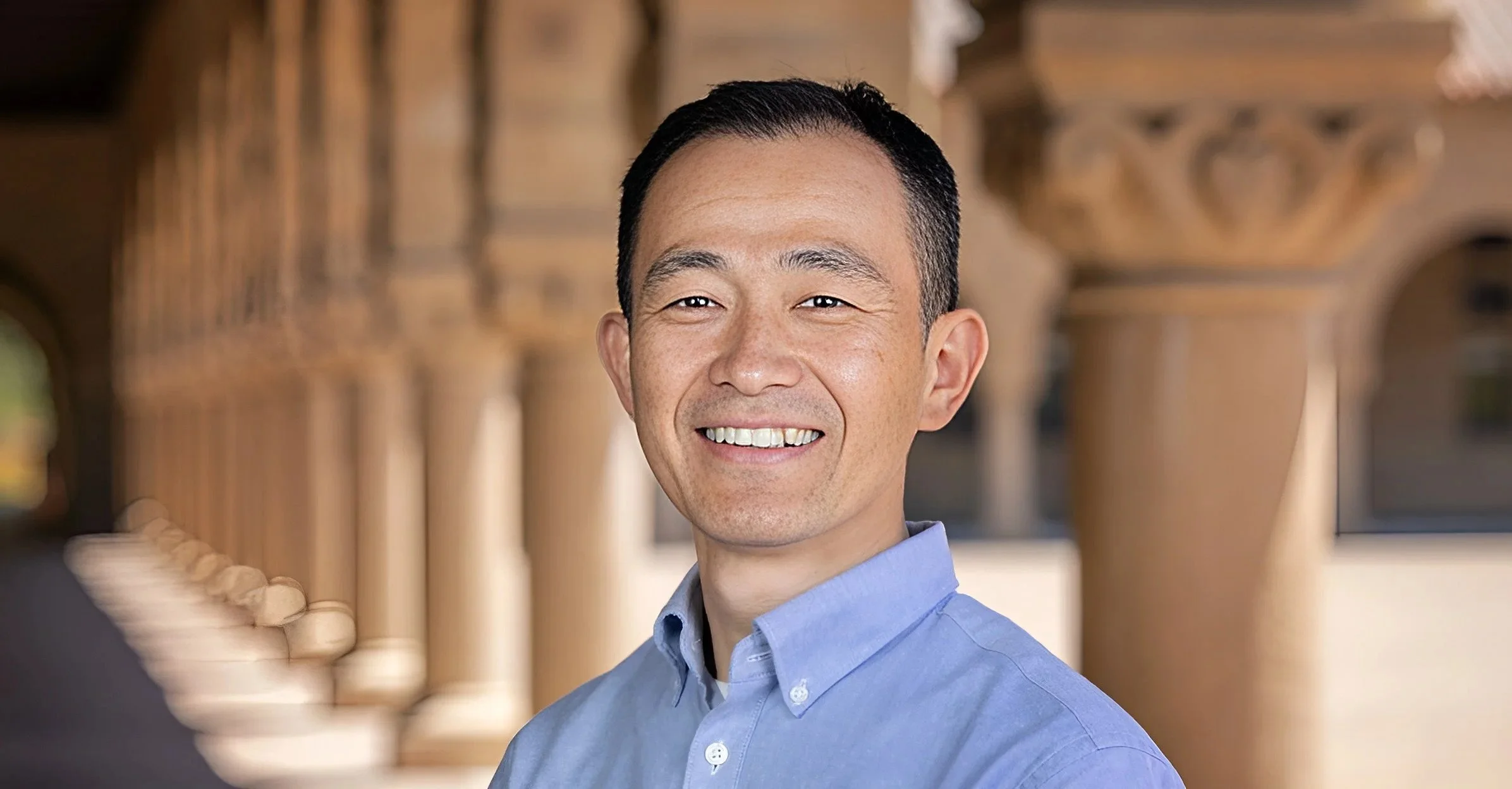
Photo: LiPo Ching / Stanford University
Professor of Biology and of Earth System Science, Stanford University; Faculty Director, Jasper Ridge Biological Preserve ('Ootchamin 'Ooyakma)
In January 2026, smoke rose over 'Ootchamin 'Ooyakma as the Muwekma Ohlone Tribe held its first cultural burn in nearly a century and a half. Ecologist Tadashi Fukami helped open the way. As faculty director of Stanford’s Jasper Ridge Biological Preserve, he has worked with the Tribe to make the preserve a place where Indigenous and Western science grow side by side.
Background
Fukami is Professor of Biology and of Earth System Science at Stanford University. He grew up near Tokyo, and visits to his grandparents in rural Wakayama sparked his interest in ecology. He holds a bachelor’s degree in biology from Waseda University (1996), a master’s in wildlife biology from the University of Tokyo (1998), and a Ph.D. in ecology and evolutionary biology from the University of Tennessee, Knoxville (2003). He was then a postdoctoral fellow at Manaaki Whenua – Landcare Research in Aotearoa New Zealand and an assistant professor at the University of Hawaiʻi at Mānoa. It was in Aotearoa and Hawaiʻi that he was introduced to the importance of Indigenous science. He joined the Stanford faculty in 2008. He has been faculty director of Jasper Ridge since 2023. Since 2025 he has co-directed the First Nations’ Futures Institute at the Stanford Woods Institute for the Environment and served on the Board of Directors of the Muwekma Ohlone Preservation Foundation. He is a Fellow of the Ecological Society of America and received the American Society of Naturalists’ Distinguished Naturalist Award in 2022.
Research Focus
Fukami studies how the history of species arrival shapes the way ecological communities develop. His work centers on “priority effects,” in which the order and timing of arrival shape which species thrive, a subject he reviewed in a 2015 Annual Review article on historical contingency. His lab tests these ideas with bacteria, fungi, protists, plants, and animals. Much of this research focuses on the yeasts and bacteria that live in floral nectar, a system he and a co-author have called “a natural microcosm for ecology,” and on how these tiny communities affect pollinators such as hummingbirds and bees. He also studies traditional ecological knowledge and seeks to practice “two-eyed seeing,” an approach that treats Indigenous and Western knowledge as distinct but complementary.
With the Muwekma Ohlone Tribe
In January 2024 Jasper Ridge announced it would add 'Ootchamin 'Ooyakma, the Chochenyo name suggested by the Tribe, to all of its signs. In an essay marking the occasion, Fukami called for “a lasting partnership with the Muwekma Ohlone Tribe.” That partnership has since taken shape. At Chairwoman Charlene Nijmeh’s suggestion, the preserve and the Tribe began holding summer campouts for Muwekma youth and families on their ancestral land in 2024.
Fukami designed a new seminar, Traditional Ecological Knowledge for Land Stewardship, offered jointly by Biology and Native American Studies. It pairs fieldwork at the preserve with guest speakers such as tribal elders. In late January 2026, Muwekma Ohlone members held a cultural burn training there, guided by the North Fork Mono Tribe. Days later, Fukami and his graduate students led the class in collecting soil from the burn sites. The resulting paper, co-authored with Chairwoman Nijmeh, Joseph Torres, North Fork Mono Chairman Ron Goode, and the students, found that the low-intensity burn only moderately affected soil nematodes that attack acorn-feeding insects. Cultural burning, the authors suggest, may help keep more acorns available for wildlife and cultural use.
In 2026 the Organization of Biological Field Stations gave Jasper Ridge its Advancing Equity Award. It cited the youth campouts, cultural burning, and research and teaching built with the Tribe. As one committee member put it, “This is what a land acknowledgement should be: a whole program.” Fukami and Associate Director Katie Glover accepted it on behalf of the preserve’s staff.
Selected Publications
Golde, Chloe L., Yuerong Xiao, Charlene Nijmeh, Joseph Torres, Ron W. Goode, et al., and Tadashi Fukami. 2026. “Effects of Cultural Burning on Insect-Associated Nematodes in the Soil.” microPublication Biology 2026. doi:10.17912/micropub.biology.002263.
Fukami, Tadashi. 2024. “'Ootchamin 'Ooyakma, What Does It Mean to All of Us?” Jasper Ridge Biological Preserve, Stanford University, January 24.
Payelleville, Amaury, Magdalena Warren, Chloe Golde, et al., and Tadashi Fukami. 2026. “Priority Effects Drive Fungal and Nematode Emergence from Insect Larvae.” FEMS Microbiology Ecology 102(5): fiag036.
Fukami, Tadashi. 2015. “Historical Contingency in Community Assembly: Integrating Niches, Species Pools, and Priority Effects.” Annual Review of Ecology, Evolution, and Systematics 46: 1–23.
Peay, Kabir G., Melinda Belisle, and Tadashi Fukami. 2012. “Phylogenetic Relatedness Predicts Priority Effects in Nectar Yeast Communities.” Proceedings of the Royal Society B 279(1729): 749–758.
Fukami, Tadashi, Ian A. Dickie, J. Paula Wilkie, Barbara C. Paulus, Duckchul Park, Andrea Roberts, Peter K. Buchanan, and Robert B. Allen. 2010. “Assembly History Dictates Ecosystem Functioning: Evidence from Wood Decomposer Communities.” Ecology Letters 13(6): 675–684.
Fukami, Tadashi, and Peter J. Morin. 2003. “Productivity–Biodiversity Relationships Depend on the History of Community Assembly.” Nature 424(6947): 423–426.